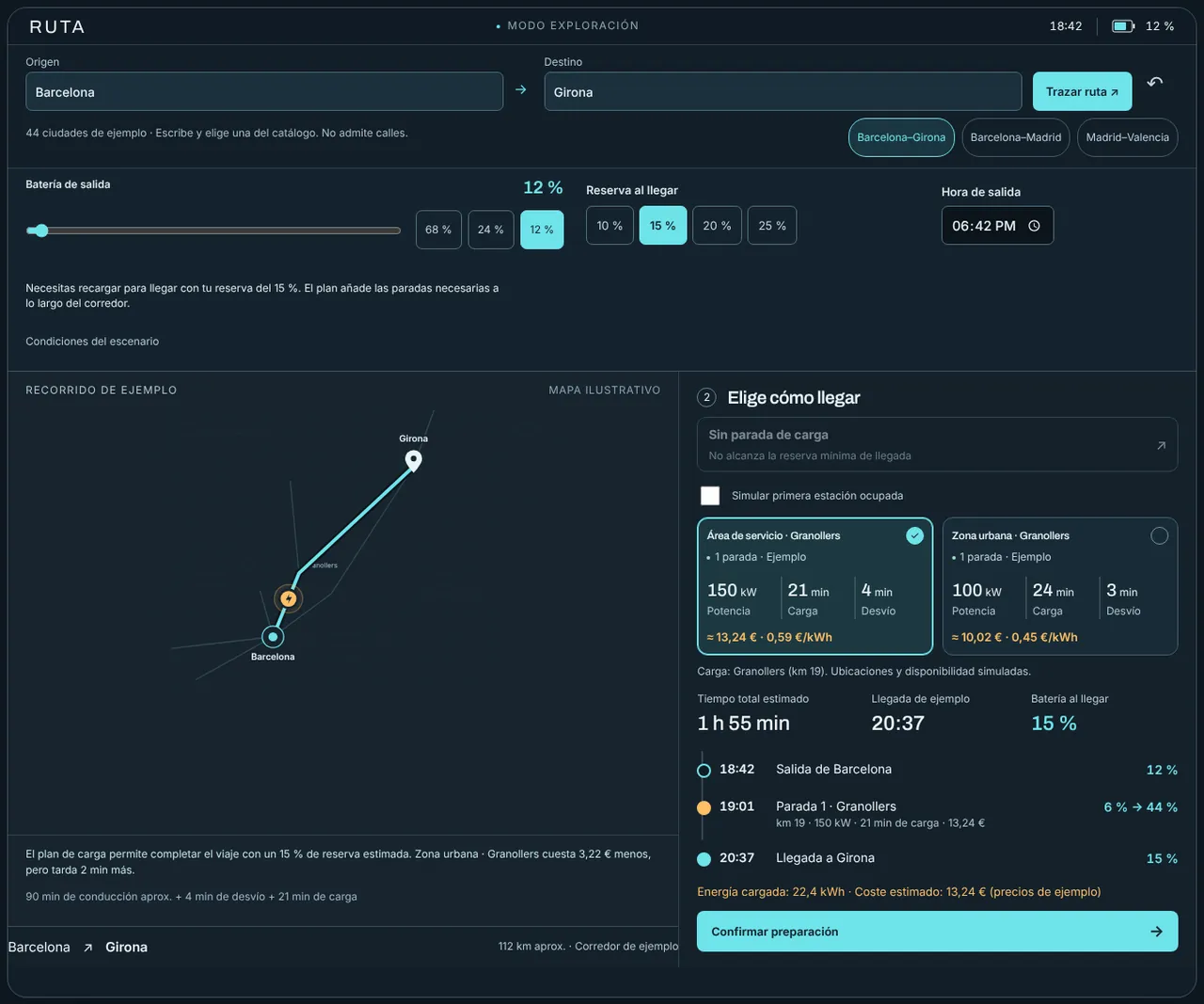
A blocked option says why
With low battery, the direct plan is disabled and reads “Does not reach the minimum arrival reserve”. The fastest stop that works is suggested, and selection is shown with text, outline and a symbol.
Independent concept · Mobility, interface
A trip planner where each charging stop shows whether it is viable, how long it takes and what it costs. It draws on my automotive interface experience, with fictional data and vehicle.

The challenge
With an electric car, arriving depends on more than distance: on the battery you leave with, where you charge, how long you wait and how much margin each person wants on arrival.
The design question: how do you make the reason for a restriction obvious, so nobody has to guess why an option is unavailable?
Design decisions
Each one can be checked in the demo.
With low battery, the direct plan is disabled and reads “Does not reach the minimum arrival reserve”. The fastest stop that works is suggested, and selection is shown with text, outline and a symbol.
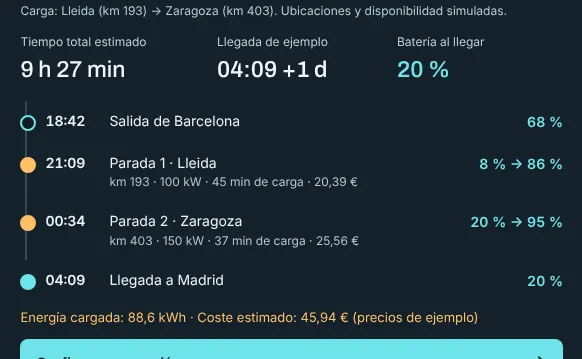
The summary shows the chosen departure time, each stop with its kilometre, charging minutes, cost and battery in and out, and the arrival. On long routes every stop is visible, not just the first.
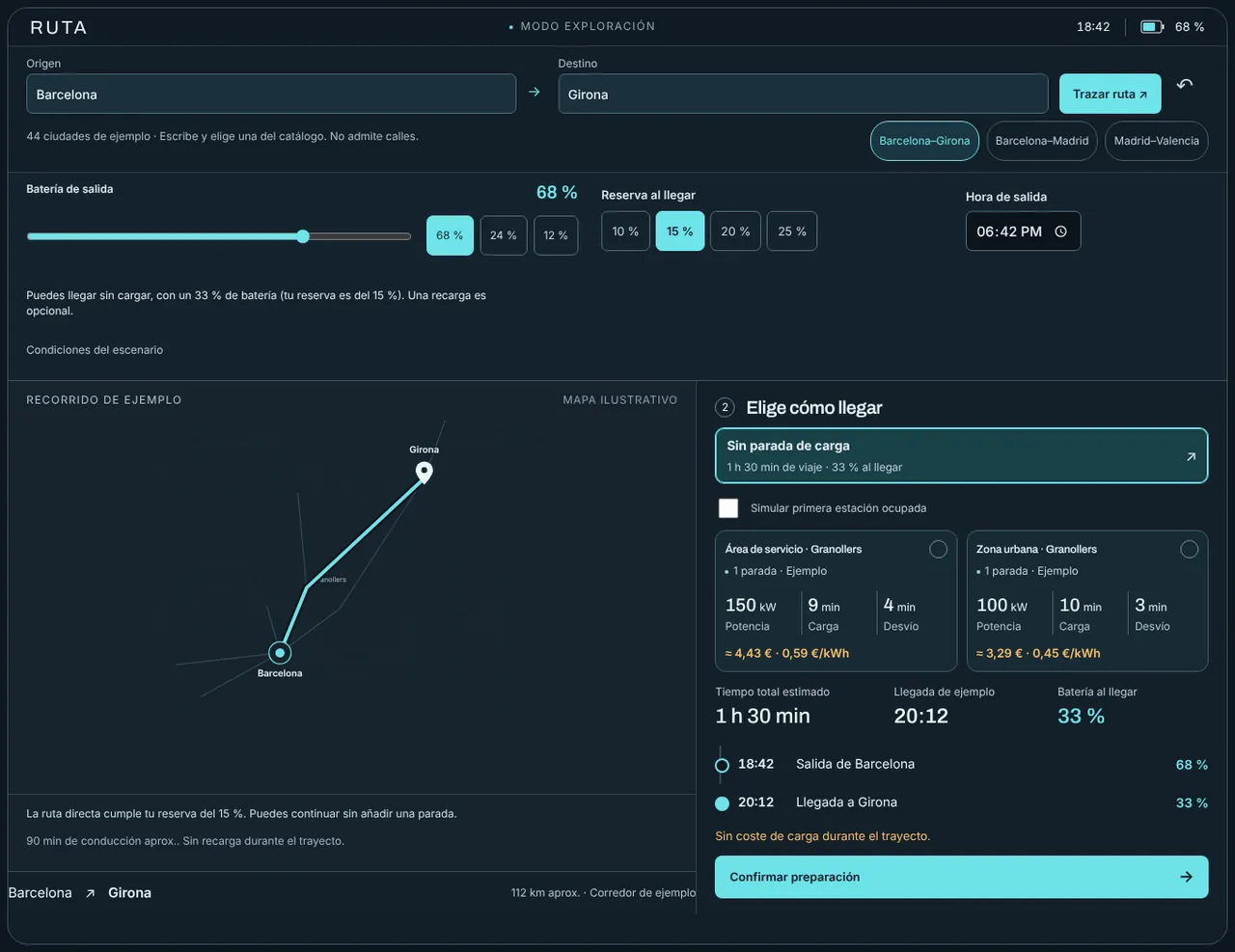
The arrival reserve can be 10, 15, 20 or 25%. Raising it adds charge to the plan and says so. Each station shows its price, and the plan compares: “costs €6 less, but takes 6 min longer”.
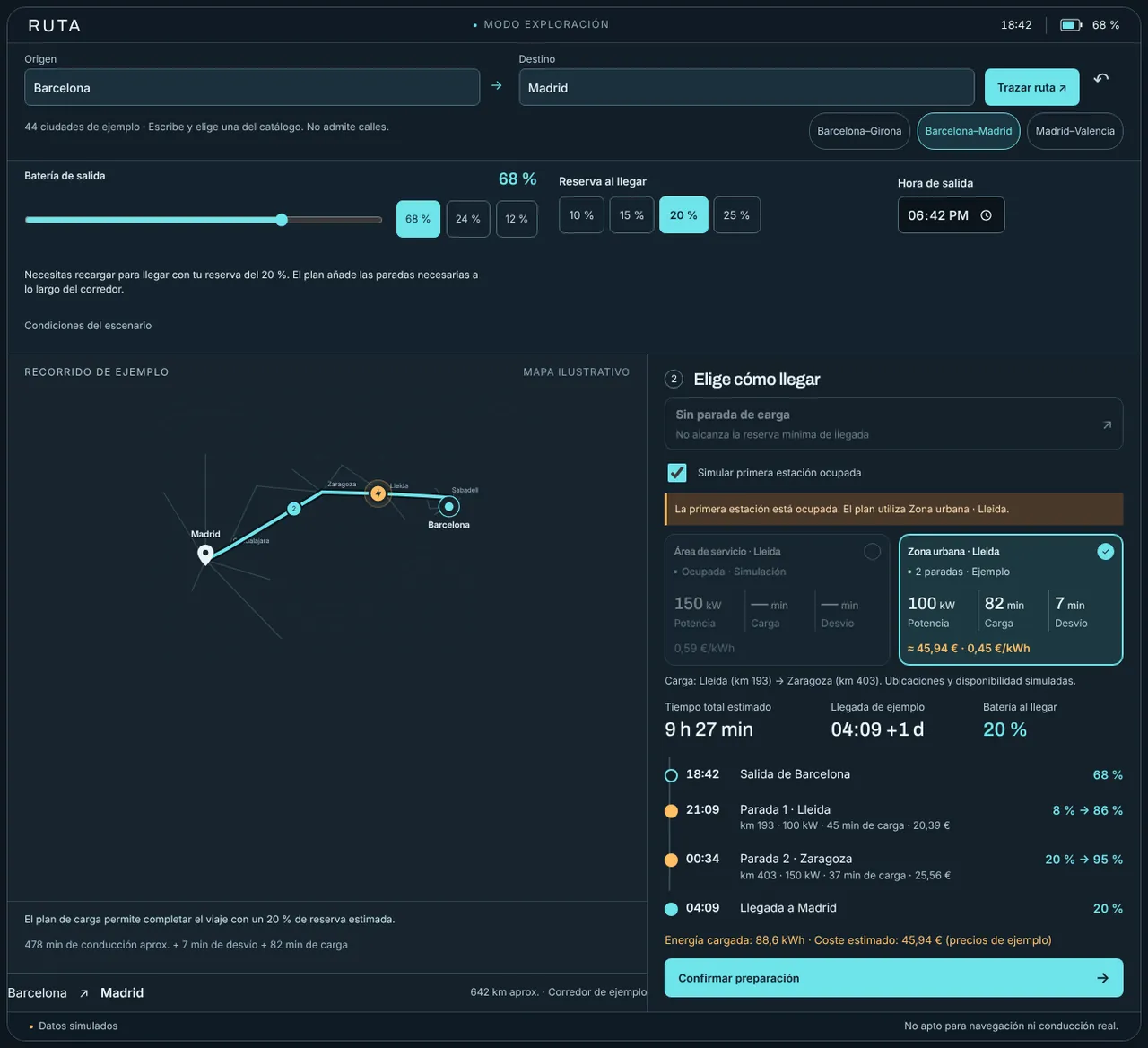
“Simulate first station busy” recalculates the plan without losing context. Errors are specific too: if a city is not in the catalogue, the interface says which one.
What you can try
To see the decisions at work, in this order.
Choose Barcelona–Madrid and look at the stops on the timeline.
Raise the arrival reserve to 25% and compare the total.
Change the departure time.
Simulate the first station being busy and confirm the plan.
Behind the interface
58 kWh, 18 kWh/100 km, 120 kW maximum power and 3 minutes to connect. Sample prices: €0.59/kWh at service areas and €0.45/kWh in town. Charging power is a simplified average.
With more time
These are hypotheses for a test I have not run yet, not results.
I can walk you through how I reached each decision in this concept.